


15 Oct What is Crisis Intervention?
Quick Answer: Crisis intervention is a short-term intervention that is time-limited and designed to give immediate assistance to an emotionally or psychologically distressed individual. It is constructed to enhance the security of the occasion, to offer alleviation for worry and distress, to steady the circumstance and to connect the dots with continuous care or resources.
If you’re thinking, “What is crisis intervention?” it is a type of immediate, short-term assistance that’s provided when an individual feels they are unable to deal with their current circumstances and need some extra support.
Crisis Intervention: First, the focus is on safety and stabilization. It can also be used to bring a sense of control to the individual and to find out the next right step.
A crisis could include suicidal thoughts, extreme emotional upset, use of drugs or alcohol, trauma, grief, a major life change, or increased or worsening mental health tendencies and/or symptoms. According to the American Psychological Association, crisis counselling or crisis intervention is “short-term counselling or psychotherapy to assist individuals experiencing highly disruptive situations or acute mental health problems.
Key Takeaways
Crisis intervention is a problem-solving process that does not attempt to solve all the person’s problems at one time, but just the active problem.
Typically, priorities are given to safety, stabilization, emotional support, assessment and connectability to appropriate resources.
Some important tips are:
- Crisis intervention is short-term and concentrated.
- Can be used during mental health, substance, traumatic, or emotional crisis.
- Improving safety and stabilization first; long-term problem solving follows.
- Crisis intervention counseling may involve listening and assessing, de-escalating, planning for safety, and referrals.
- A crisis intervention specialist may play a key role in preventing a classification of the type of assistance required.
When longer-term mental health care or addiction care is required, crisis intervention cannot take the place of the follow-up care.
What is Crisis Intervention?
Crisis intervention is a brief, immediate mental health intervention for someone in an emerging crisis who is emotionally distressed or in a psychological crisis. It is a short-term, personally supportive counseling technique for individuals who have experienced a very disruptive life event, according to the APA Dictionary of Psychology.
What is Crisis Intervention in Mental Health?
Crisis intervention is a brief, immediate mental health intervention for someone in an emerging crisis who is emotionally distressed or in a psychological crisis. It is a short-term, personally supportive counseling technique for individuals who have experienced a very disruptive life event, according to the APA Dictionary of Psychology.
Mental health crises can vary from state of mind to state of mind. A person might feel panicked, hopeless, confused, and be extremely agitated, feel “out of reality,” or feel like you can’t cope. Urgent crisis assistance may be needed for suicidal thoughts too. SAMHSA suggests reaching out to someone in distress or crisis by calling 988 or by sending a text.
What is a Crisis Intervention Program?
One question people also ask is, how do crisis intervention programs work, and what does a crisis intervention program support? A crisis intervention program is a structure with a mission to quickly respond to individuals in behavioral health or emotional crisis.
Not all providers offer every program and they may differ from community to community. They can give telephone or text support, a mobile crisis response, a risk assessment, short-term stabilization, and connections or referrals to treatment. SAMHSA’s national guidance on crisis care includes the following three aspects of a good crisis system: ‘Someone to call’, ‘Someone to respond’ and ‘Safe place to receive help’.
The appropriate answer is dependent on the individual’s requirements and level of risk.
How do Crisis Intervention Services Work?
Crisis intervention starts with a focus on the person’s current situation. What happened? Is the person safe? Are they having thoughts about hurting themselves or others? Are drugs and alcohol used? Where would you like to go if you’re feeling unsafe? Do they require emergency medical attention?
The support can then be directed to reducing the distress and developing a realistic plan once immediate concerns are understood. This may include a family member, crisis worker, mobile crisis unit, medical care, mental health specialist, or addiction treatment professional, depending on the specific situation.
What Happens During Crisis Intervention Counseling?
Typically, the counseling does not involve years of therapy but is practical and focused on the present. A counsellor may begin with listening and letting the person tell him/her what has happened. The counselor can then determine current issues of concern, risk, support resources and help the individual determine what action should take place next.
Discussion should be done in a nonjudgmental and calm manner. Instead of being directly confrontational with individual emotions or directing patients to “cheer up,” the emphasis is on validation of their experience.
According to the APA, counselling may involve professional assistance with techniques such as active listening, guidance, discussion and clarification.
What Does a Crisis Intervention Specialist Do?
A crisis intervention specialist is an individual who can assist in emotional, physical, mental health or substance crisis situations. They can function in various capacities based on their educational and personal background, employer experiences and/or type of crisis.
They will be able to assess the person’s immediate needs, assist in de-escalating the emotional response, provide information about other supports, develop a safety plan and refer the person to the appropriate services. Depending on the situation, outpatient treatment could be the next step. With others, more advanced care or an emergency response might be required.
The crisis person is not a ‘fixer’. Their job is to work towards making the situation of the moment safe and more manageable.
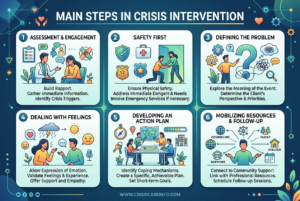
What Are the Main Steps in Crisis Intervention?
No one model of crisis intervention is adopted in every setting. Discussed below is one of the commonly mentioned models that involves the following steps: Problem definition, ensuring safety, providing support, exploring alternatives, making plans, and gaining commitment to the plan.
In reality, crisis intervention is most frequently reduced to a number of basic steps:
- Assess immediate safety. Decide if there is an imminent danger of harm.
- Listen and understand. Allow the person to express what they are feeling.
- Reduce immediate distress. Where possible, provide a quieter, safer environment.
- Find options and options. Consider people, services, and coping resources that could be helpful.
- Establish an action-oriented plan. Determine what needs to be done to proceed.
- Access to continued care. Schedule follow-up support, as needed.
- The process should be flexible as each crisis is different.
When is Crisis Intervention Needed?
As a person’s distress grows to the point that the person can no longer safely or effectively handle the situation by him or herself, emergency intervention is indicated.
It may occur following a traumatic experience, a loss, problems with relations, a substance abuse problem, psychiatric symptoms, or stressors.
Signs of a problem may be thoughts about death, high anxiety, drastic mood swings, disorganized thinking, odd behavior, high excitement, or trouble concentrating. According to SAMHSA, a person’s thoughts, mood, or way of functioning might be changing, which could mean that they’re in need of professional support.
Don’t delay seeking assistance because not every warning sign has been identified if safety is an issue.
Crisis Intervention for Addiction and Substance Use
It is also possible to have drug use and mental health problems go hand in hand. When someone consumes alcohol or drugs, they become more impulsive, judgment less, emotional issues grow greater, and/or they face problems with the already existing mental disorder. Another individual could have a withdrawal crisis, overdose potential, family issues, or issues stemming from continued drug use.
Crisis intervention may be of benefit in these scenarios to identify the safest course of action. This could include a medical evaluation, withdrawal management, mental health care, addiction treatment, or a higher level of professional care.
Crisis support is not for recovery treatment for addiction. Rather, it may provide a structure that takes them out of the crisis and into a more stable environment.
Need help deciding what comes next?
If a family is in a situation where they feel like they have to do something right now, Intervention 911 can educate the family about intervention and treatment alternatives for substance abuse, mental health situations, and family crises. Early outreach can help alleviate uncertainty and help chart a clear, action-forward path.
How Can You Help Someone Who Is in Crisis?
Firstly, do not panic and listen. Allow the person to talk. Don’t argue, lecture, judge or discount their emotions. Don’t feel that you have to have the perfect answer. It can make a difference to be there and help the person get in touch with trained help.
When suicide is a concern, it isn’t off-topic to address suicidal tendencies outright. 988 Lifeline suggests that you be direct, listen, be non-judgmental, assist the person to stay safe, help connect them with resources to support, and follow up.
Call 911 or proceed to the closest Emergency Department (ED) if there is an immediate physical threat or medical emergency.
Professional crisis intervention is important because:
When someone is really distressed, thinking clearly, comparing options, and figuring out what to do next all may be difficult. Professional crisis intervention services will provide structure in an unpredictable situation.
A skilled professional can help to move the dialogue in the direction of immediate security, and also to work toward finding answers to what to do next. This can be particularly helpful if mental health and drug use are occurring concurrently.
Crisis intervention isn’t meant to provide a resolution to all long-term problems in a single chat. Its use is more limited to contain the situation and assist the individual to get to the next level of support.
For many families, that first step of organization can help them cope with a challenging situation.
Why Professional Crisis Intervention Matters
As important as knowing what crisis intervention is, it’s crucial to understand where and how to find help. But, when the addiction, emotional, or behavioral health troubles become too difficult for the individual or the family to manage, crisis intervention services become available to provide some structure in a crisis situation.
Intervention 911 can help families with obstacles they may be facing related to addiction and addiction professionals. Instead of dealing with a serious situation by themselves, families can get professional help, learn about all their treatment options, and, by their circumstances, formulate a plan.
Call Intervention 911 today to see if there’s a solution that can help your loved one and which form of intervention or treatment may be suitable.
For people at immediate risk or having a medical emergency, call 911 or proceed to the nearest emergency room. If you or a person you know is in a mental health, suicide, or substance use crisis, dial or send a text message to 988.
Frequently Asked Questions About Crisis Intervention
What are examples of crisis interventions?
Examples include crisis hotline counseling, safety planning, suicide-risk assessment, mobile crisis response, de-escalation, short-term counseling, emergency psychiatric evaluation, and connecting someone with mental health, addiction treatment, medical, or community support.
What are the five steps of crisis intervention?
Models differ, but five practical steps are assessing safety, understanding the immediate problem, providing calm support, identifying coping options and resources, and creating a clear action plan that includes appropriate follow-up care.
What not to say to someone in crisis?
Avoid saying things such as “get over it,” “others have it worse,” or “you are overreacting.” Do not shame, argue, lecture, or promise secrecy when someone’s immediate safety may be at risk.
How to help someone in crisis mode?
Stay calm, listen without judgment, ask what they need, assess immediate safety, and connect them with professional support. If suicide is a concern in the U.S., call or text 988 for crisis assistance.
What qualifies as crisis intervention?
Crisis intervention generally refers to immediate, short-term support intended to stabilize someone experiencing significant psychological or emotional distress. It focuses on safety, coping, problem-solving, and connection to further care rather than long-term psychotherapy.
What are the 5 C’s of crisis?
Different organizations use different “5 C’s” frameworks, so there is no single universal clinical standard. Common crisis-response themes include calmness, communication, connection, coping, and continued support, but terminology varies by training model.
How to tell if a person is mentally unstable?
“Mental instability” is not a precise diagnosis. Warning signs that may warrant professional help include severe mood or behavior changes, confused thinking, inability to function normally, suicidal thoughts, extreme agitation, or losing touch with reality.
What is the best thing to do in a crisis?
Focus first on immediate safety. Stay with the person when it is safe to do so, listen without judgment, and contact qualified support. In the U.S., call or text 988 for behavioral health crisis assistance.
What’s the worst thing you can say to a depressed person?
Dismissive comments such as “just cheer up,” “you have nothing to be depressed about,” or “others have it worse” can shut down communication. Listen, acknowledge the person’s feelings, and encourage appropriate professional support instead.
Disclaimer
This article is provided for educational and informational purposes only and is not a substitute for diagnosis, psychotherapy, medical advice, emergency services, or individualized treatment from a qualified healthcare professional. If you or another person is in immediate danger or experiencing a medical emergency, call 911 or go to the nearest emergency department. In the United States, people experiencing mental health, suicide, or substance use crises can call or text 988 for 24/7 crisis support.
References
- American Psychological Association, APA Dictionary of Psychology: “Crisis Intervention.” The APA defines crisis intervention as brief counseling or psychotherapy used after highly disruptive experiences and as short-term emergency psychological intervention during acute mental health crises.
APA Dictionary of Psychology: Crisis Intervention - Substance Abuse and Mental Health Services Administration (SAMHSA): Crisis Help: Suicide, Mental Health, Drug, and Alcohol Issues. SAMHSA Crisis Help Resources
- SAMHSA: National Behavioral Health Crisis Care Guidance, including guidance on crisis contact services, mobile crisis response, and stabilization services.
SAMHSA National Behavioral Health Crisis Care Guidance - 988 Suicide & Crisis Lifeline: Guidance for helping someone experiencing emotional distress or suicidal thoughts, including listening, safety, connection, and follow-up. 988 Lifeline: Help Someone Else
- Verywell Mind: “How a Crisis Intervention Provides Mental Health Support.” Overview of crisis intervention, common situations in which it is used, and a commonly discussed six-step intervention model. (Verywell Mind)
Sorry, the comment form is closed at this time.