
05 Oct How Does an Intervention Work?
Quick Answer: How does intervention work? Family members, friends and a professional interventionist convene for a meeting to take place called a professional intervention, a structured and supportive conversation to discuss the harmful drug or addictive behavior. The aim is to promote treatment whilst introducing boundaries and limits that can be accomplished. The aim is to promote treatment whilst introducing boundaries and limits that can be accomplished.
If you’ve witnessed the abuse of alcohol or drugs in a family member, then you may have asked yourself “How can an intervention help?” and “How does it work?” Intervention is an organized discussion to help someone understand the effect his/her behavior has on his/her family, relationships, work, and health.
Before things get really bad, the days of a loved one can be transitioned by a thoughtful plan formed after collaboration with a professional interventionist and by linking the individual to the proper treatment. Mayo Clinic states that intervention is an organized meeting between family, friends, and health and/or addiction specialists, and it is well planned and in advance if it is needed.
Key Takeaways
Intervention is not just the act of meeting everyone in one room to lecture the addicted person for his or her drug or alcohol use. This means pre-treatment, careful communication, treatment planning and follow-on treatment. When a family has a better understanding of how the intervention works, then better fear reduction and realistic expectations can be provided as they enter the intervention.
A professional intervention is about specific behaviors and their consequences only, not about blame. Family members can tell about their experiences, why they are concerned, and a treatment solution. Mayo Clinic says if the person does not agree to get assistance, the interventions can include a plan of care and specified interventions.
- The planning group gets ready prior to the meeting.
- The help of a professional can direct the family and intervention team.
- Participants speak about the concerns and consequences.
- The appropriate treatment options should be known a priori.
- The family members set boundaries they are willing to uphold.
- Support after the meeting is still key!
- Prior to an intervention, consider keeping children safe.
How Does an Intervention Work?
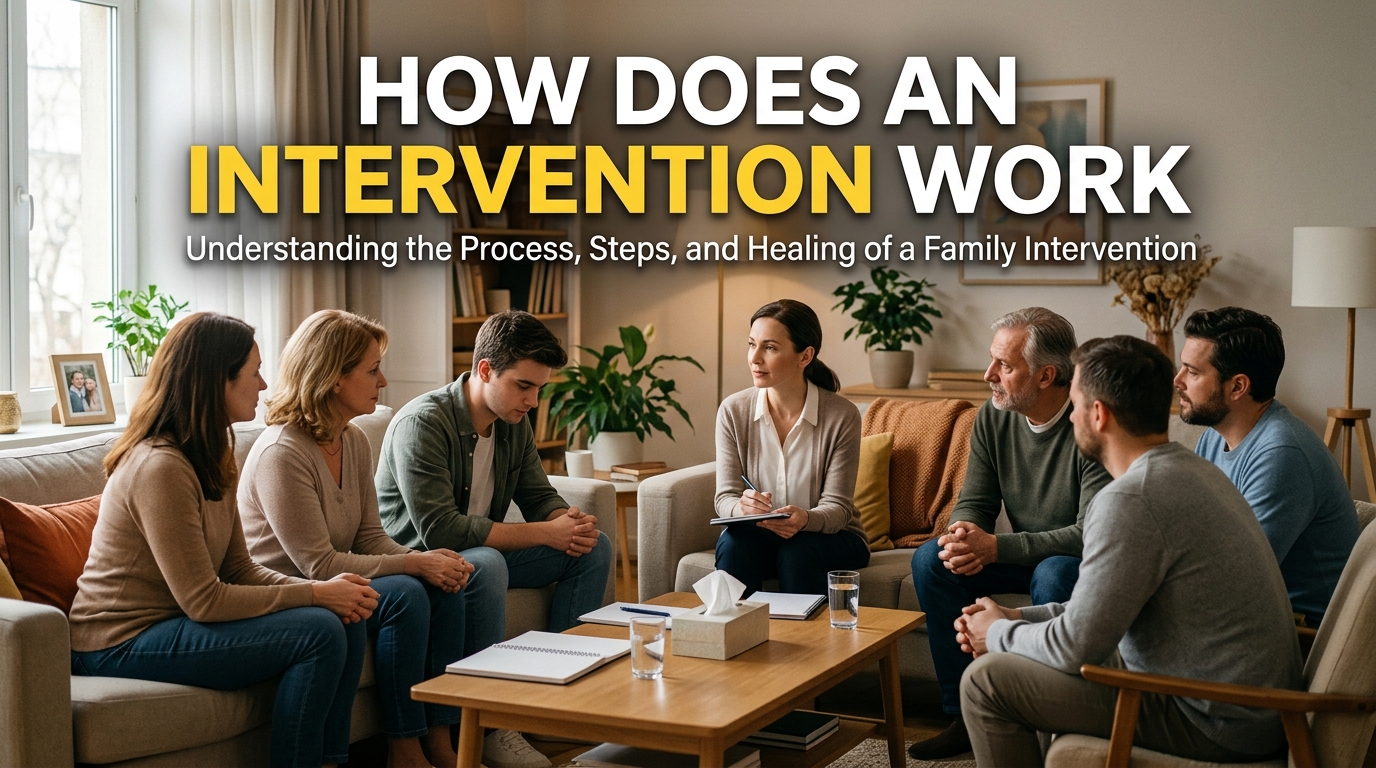
But how does an intervention work in the real world? This typically starts with someone who reduces their substance use entering the room. Family members and trusted persons come together to talk about concerns, collect data, pick participants, and decide what they wish to communicate. Having a professional interventionist running the planning process will move the discussion forward while avoiding an argument.
In the meeting, turns are taken by people to express concern & talk about specific experiences. Not intended for embarrassment or punishment of the individual. Rather, it is the group that will explicate the effect of the behavior and provide a practical course of treatment. One intervention can be asking the individual to accept the treatment offered at the moment while making it clear what the limits are for loved ones if he or she declines to go into treatment, according to the Mayo Clinic.
What Are the Steps of an Intervention?
The first step is to plan. The family notices the concern, becomes educated about treatment options,, and thinks about the need for intervention by a professional. The intervention team is then determined. People who’re understood, believed, and trusted by the person will be more useful than individuals who may actually spur more strife. Intervention teams typically involve multiple key individuals in the individual’s life, according to Mayo Clinic.
The next steps are to write statements, select a safe space, make treatment plans and set boundaries. Feedback during the intervention is directly and calmly conducted by each person. Thereafter, the individual is provided with a particular treatment option. Follow-up is then a must. Family members can attend counselling, support groups, and other events to encourage healthier relationships.
How Does an Alcohol Intervention Work?
So if you’re wondering how an alcohol intervention work, the basic process is comparable to intervention in other sorts of issues involving substance abuse. Specific examples of families’ alcohol-related issues, how this affects relationships or life and a treatment plan. The dialogue should be about behavior observed instead of insults, labels, or arguments.
Alcohol issues can impact a person and those who they are close to. Family counseling can be a crucial part of relationship enhancement and recovery, says the National Institute on Alcohol Abuse and Alcoholism. In addition, NIAAA suggests techniques for encouraging behavior change, such as motivating someone to cut back or change their drinking patterns and family-oriented interventions.
How Does a Drug Intervention Work?
If you are wondering how does an drug intervention works, the fundamental rule is comparable, except for the fact that more of it may want to be completed for the specific scenario. The kind of substance, history of use, medical complications, mental health problems and past treatments can all make a difference in a proper approach.
Drug intervention is NOT a confrontation. The family has specific incidents to describe, the ability to explain how substance use affects the family, and to offer treatment possibilities. Doing this is especially crucial if there is a history of violence, suicidal behavior, serious mental illness, or multiple substances. The Mayo Clinic in particular says there is a need for professional involvement if safety or serious mental health issues are involved.
What Is a Professional Intervention?
A professional intervention is an organized intervention with a professional individual who will guide the family through the process of dealing with drug use and/or related issues. But an interventionist might be able to give the family support in preparing statements, in deciding who to attend the intervention, for what they foresee as the families’ potential answers, for setting boundaries and for making treatment arrangements before the actual intervention meeting.
This is important support, as it can be an emotional time. There can be years of anger, fear, disappointment, or guilt accumulated in a family regarding its loved one’s drug and/or alcohol use. They usually need a trained professional to help to refocus the discussion to specific concerns and tasks for the next steps. However, Mayo Clinic suggests you talk to an addiction professional, like an addiction counselor, psychologist, social worker, psychiatrist, or interventionist, when planning an intervention.
What Should Family Members Expect During an Intervention?
Emotions are to be expected among family members. Those approached might become angry, defensive, embarrassed, confused, and/or turn down treatment. But this does not necessarily indicate intervention failure. To express clearly, to offer a chance for change; and to set proper limits.
Before the meeting, the participants should have an idea of what they want to say and what they will do if they can’t be treated. Try not to make statements you can’t keep. An intervention should also occur in a setting in which everyone can be physically protected. If there is a risk of violence or self-harm that might be managed, then it’s best to seek professional advice before going ahead.
When Should You Consider Intervention Services?
If substance use is causing significant issues, but the individual cannot see it or is constantly rejecting treatment, intervention services can be of help. It can manifest itself as damaged relationships, money issues, legal issues, unsafe behavior, decreased work or school performance, or repeated attempts to quit without success.
A situation does not necessarily warrant an intervention. Work with some families may be accomplished in a more non-confrontational manner. According to NIAAA, Community Reinforcement and Family Training, or CRAFT, helps concerned family members to persuade the family member to get and stay in treatment; however, it doesn’t necessarily induce the typical “countermovement.” Each person and family has its own specific approach that is determined based on the person’s or family’s circumstances, safety and treatment requirements.
What Not to Say During an Intervention?
It is not a personal thing; professional intervention only deals with certain behaviors and the consequences of certain behaviors. Family members can tell about their experiences, why they are concerned, and a treatment solution. Mayo Clinic suggests that if the person refusing help is not accepting it, there can be an intervention plan with specified actions, including a treatment plan.
Do not use insults, accusations, exaggerated statements, threats you cannot follow through on or statements intended to embarrass the person. When statements such as “you are ruining everyone’s lives” don’t fit with the conversation at hand, it can verge on a fight. Instead, elaborate on specific actions and their effect on you.
Use statements that start with “I”. This may be something such as, “when you drove drunk I was afraid” or “I was afraid for your health.” Preparing notes with your ideas, concerns, and hopes for improvements in the child is possible, as Mayo Clinic noted, and, as Mayo Clinic reminded, it’s a good idea to be specific about the incidents.
What to Say at the Beginning of an Intervention?
The beginning should be gentle, simple,, and quiet. One approach might be: “I think we’re here to say we’re concerned about what’s been going on and concerned about you and think we should talk to you about that; we should get some help.”
The goal is security, not to call for a solution now. Participants can declare their concern, provide information, and make it known that it is an offer of treatment, based on their importance. When beginning the night, keep it classy and have a better chance for the night to move along.
At the meeting, participants can share their worries and provide support. Follow-up is provided whether or not treatment is accepted immediately following the conversation. Family members might need to set some boundaries, support treatment involvement, attend family sessions,, or get help for themselves. Most of the time, recovery will not happen in one go.
How Long Does an Intervention Last?
Although the meeting itself could last a relatively short time, the planning process can last longer. Its length will be determined by the number of subjects involved, the complexity of the situation, the arrangements for treatment, and the amount of preparation required. No set time limit guarantees success.
The focus should not be on the clock; more important is that there is a clear purpose and everyone has an idea about what they will cover. Just because a meeting is time-sensitive doesn’t mean important points are distributed and resolved, and just because it’s a long meeting doesn’t mean everyone is fully engaged. A family professional can assist the family in deciding on a sensible construction and maintain the dialogue on the topic.

Can an Intervention Force Someone Into Treatment?
An intervention is designed to convince someone of the need to help in most cases instead of attempting to persuade him or her to change. The family can provide treatment and set the boundaries, but recovery is about the individual and its motivation and involvement in the treatment.
That is why it is important to get ready. The family should be aware of the extent of treatment and come up with realistic limits of what can be done. NIAAA emphasizes family involvement and support but still makes it abundantly clear that it’s the person with the alcohol problem who has to deal with it.
What Is the Success Rate of an Intervention?
No success rates will be universally applicable to all interventions. Different people can have different responses based on their substance use and addiction in addition to their receptivity of interventions, family dynamics, safety concerns, availability of treatment, and the type of intervention applied.
Also, it is important to do more than focus on the immediate response to an intervention in deciding whether an individual will receive treatment. A managed dialogue can be helpful or a communication tool, a factor in the setting of limits, or a catalyst for subsequent treatment. Some family-based responses come with evidence of their effectiveness, and NIAAA identifies a number of structured responses for supporting people with alcohol problem(s).
Get Professional Help With an Intervention
If you are studying up on an intervention because a family member/friend is battling an addiction, you don’t need to do the preparation yourself. Intervention 911 can be a tool that can help facilitate family conversations about options, readiness for difficult reactions, preparation for the intervention process and next steps.
It is important not to wait until a crisis happens before seeking for help. Contact Intervention 911 and learn about opportunities for professional intervention support and what your family may need.
Take the Next Step With Intervention 911
Knowing how an intervention goes is important, but every household circumstance is unique. An intervention should be designed based on the need of the person, the family situation, available treatment, and safety. Confrontation can be avoided with a careful and considered dialogue around support, stances, and recovery.
If you are thinking an alcohol or drug intervention is a necessary step, Intervention 911 is here to explain the process, and get you ready for the next. You can call today and find out more about professional intervention/counsellor solutions. Don’t have to solve it on your own.
Sorry, the comment form is closed at this time.